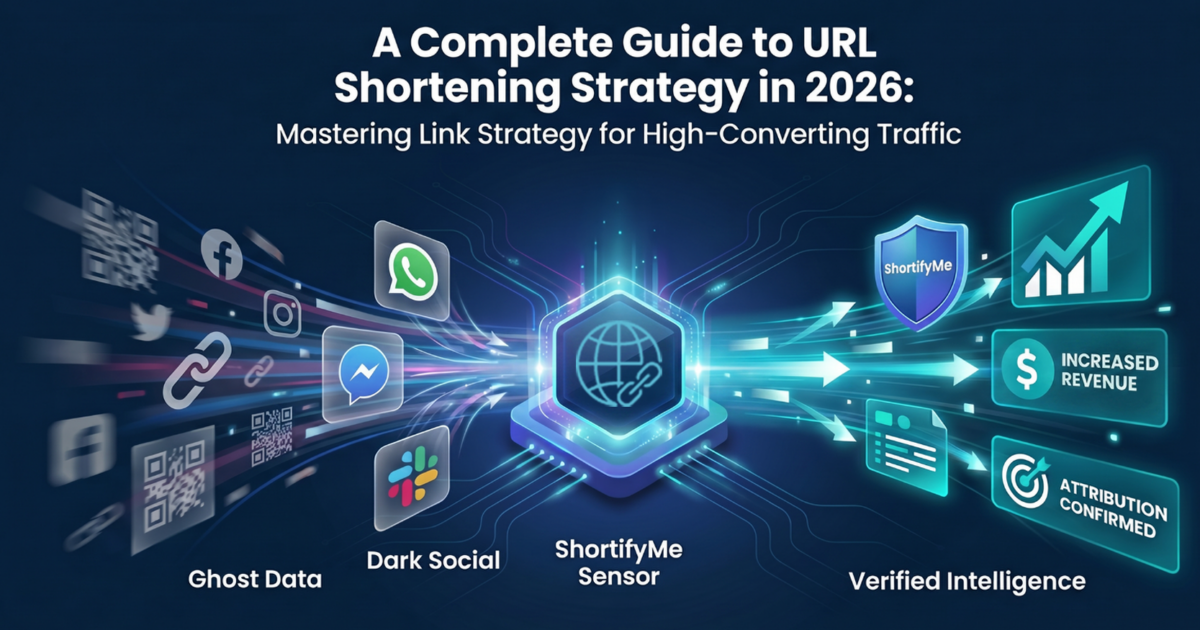
In 2026, a URL shortening strategy is no longer just about shortening links. It is about building a technical layer that captures first-party intent, bypasses browser tracking limits, and establishes trust before the user ever lands on your page.
Most marketing teams are currently flying blind. They rely on “click counts” as their primary success signal. On paper, campaigns look successful. In reality, many teams cannot explain why a significant amount of that traffic never reaches the checkout page. If your analytics shows 1,000 clicks but only 700 sessions, you aren’t just missing data; you are burning 30% of your CAC on users who bounced during a 200ms lag.
This is where short link tracking changes the equation. A link is no longer a passive redirect. It becomes a controlled entry point that records intent at the server level, before browser privacy rules or ad-blockers can strip away attribution data.
The digital environment itself has shifted. As AI-driven search filters and stricter browser policies have made users skeptical about anonymous URLs. In 2026, “Link Skepticism” is a conversion killer. If your link looks generic, it gets ignored.
At ShortifyMe, our platform was built for teams operating at scale. While our Free Package provides a foundational starting point for tracking, our Premium tiers are built for professionals who need server-side attribution, real-time link analytics, and global edge routing to eliminate data leakage.
This guide provides the technical roadmap you need to audit your link infrastructure, master multi-channel attribution, and use server-side analytics to stop losing revenue to “Ghost Clicks.” You will learn how to transform your URLs into high-performance assets that protect your brand reputation, preserve your data integrity, and drive actual growth instead of just reporting numbers.
 Generic shorteners fail because they lack domain authority and trigger immediate distrust from both users and browsers. In a privacy-first environment, branded and verified links are prioritized. Users are 39% more likely to click branded short links compared to generic ones. That gap isn’t just about aesthetics; it is about verified credibility.
The technical structure behind your link is your new security perimeter. ShortifyMe approaches this with two distinct environments:
Generic shorteners fail because they lack domain authority and trigger immediate distrust from both users and browsers. In a privacy-first environment, branded and verified links are prioritized. Users are 39% more likely to click branded short links compared to generic ones. That gap isn’t just about aesthetics; it is about verified credibility.
The technical structure behind your link is your new security perimeter. ShortifyMe approaches this with two distinct environments:
Furthermore, AI systems now evaluate links as signals of authority. In the AIO era, generic redirects are “orphan” signals. A branded shortener provides a consistent Entity Association signal, telling search engines that this traffic and this authority belong strictly to your brand.
 A 2026 link audit is a 5-point technical verification process that ensures HSTS compliance for redirects, metadata accuracy, and speed so every link is secure, trackable, and built for performance.
Performance begins with speed. Every 100ms of mobile redirect latency reduces conversion by 1%. ShortifyMe’s core infrastructure is built for speed, and our Professional Tiers use Global Edge-Priority Routing to place your data physically closer to your user’s hardware. This infrastructure is no longer optional for high-volume campaigns; it is the only way to stop losing revenue to slow redirects.
The audit framework focuses on three technical standards:
A 2026 link audit is a 5-point technical verification process that ensures HSTS compliance for redirects, metadata accuracy, and speed so every link is secure, trackable, and built for performance.
Performance begins with speed. Every 100ms of mobile redirect latency reduces conversion by 1%. ShortifyMe’s core infrastructure is built for speed, and our Professional Tiers use Global Edge-Priority Routing to place your data physically closer to your user’s hardware. This infrastructure is no longer optional for high-volume campaigns; it is the only way to stop losing revenue to slow redirects.
The audit framework focuses on three technical standards:
 ShortifyMe’s premium redirect technology uses device-aware logic to automate routing based on the user’s hardware environment, maximizing conversion outcomes. Technical superiority is achieved through the “one link, three destinations” rule, ensuring users land in the most optimized environment:
 Dark Social refers to untracked traffic from private apps like WhatsApp, Slack, and DMs. ShortifyMe captures this data at the server level, before privacy shields can strip the signal.
Most marketers are currently struggling with the Google Analytics 4 (GA4) “black hole” where high-value traffic is dumped into “Unassigned,” “Not Set,” or “Direct” buckets. ShortifyMe acts as a critical data pre-processor. We catch the source and intent data at the moment of redirect; before the browser has a chance to “sanitize” the URL, ensuring your GA4 actually receives the data you are paying for.
This creates a reporting gap that hides real performance drivers. By the time a browser loads your landing page, 30% of your attribution data has already been stripped. ShortifyMe’s server-side tracking captures this “Dark Social” data, giving you a clear view of your real performance drivers.
Dark Social refers to untracked traffic from private apps like WhatsApp, Slack, and DMs. ShortifyMe captures this data at the server level, before privacy shields can strip the signal.
Most marketers are currently struggling with the Google Analytics 4 (GA4) “black hole” where high-value traffic is dumped into “Unassigned,” “Not Set,” or “Direct” buckets. ShortifyMe acts as a critical data pre-processor. We catch the source and intent data at the moment of redirect; before the browser has a chance to “sanitize” the URL, ensuring your GA4 actually receives the data you are paying for.
This creates a reporting gap that hides real performance drivers. By the time a browser loads your landing page, 30% of your attribution data has already been stripped. ShortifyMe’s server-side tracking captures this “Dark Social” data, giving you a clear view of your real performance drivers.
Phase I: Why Generic Shorteners Are Dying in 2026
Generic shorteners fail because they lack domain authority and trigger immediate distrust from both users and browsers. In a privacy-first environment, branded and verified links are prioritized. Users are 39% more likely to click branded short links compared to generic ones. That gap isn’t just about aesthetics; it is about verified credibility.
The technical structure behind your link is your new security perimeter. ShortifyMe approaches this with two distinct environments:
- ShortifyMe Free Account: Operates on a shared domain. This is a monitored, vetted neighborhood built to protect small users from reputation issues.
- ShortifyMe Premium Account: Operates on your own branded domain. This is a private estate. In a zero-trust internet, isolation is the only 100% insurance policy against reputation contamination.
The “Public Pool” Problem
When you share a domain with thousands of other users, you are at the mercy of their behavior.| Risk Factor | Impact on Campaign |
|---|---|
| Reputation Contamination | A single spammer on a shared domain can trigger a “Suspect Link” warning in Chrome for everyone. |
| Firewall Friction | Corporate filters and AI-driven security layers auto-block high-volume anonymous redirectors. |
| Data Leakage | Most free tools monetize your audience data via third-party cookies, effectively selling your traffic data to competitors. |
Phase II: The 2026 Link Audit Checklist (The SOP)
A 2026 link audit is a 5-point technical verification process that ensures HSTS compliance for redirects, metadata accuracy, and speed so every link is secure, trackable, and built for performance.
Performance begins with speed. Every 100ms of mobile redirect latency reduces conversion by 1%. ShortifyMe’s core infrastructure is built for speed, and our Professional Tiers use Global Edge-Priority Routing to place your data physically closer to your user’s hardware. This infrastructure is no longer optional for high-volume campaigns; it is the only way to stop losing revenue to slow redirects.
The audit framework focuses on three technical standards:
| Requirement | Standard | Benefit |
|---|---|---|
| Protocol | HSTS / SSL | Prevents “Not Secure” browser warnings that kill trust instantly. |
| Redirect Speed | Edge-Priority | Eliminates “Ghost Clicks” by placing data near the user’s hardware. |
| Tracking | UTM Lowercase | Ensures clean data for AI-driven dashboards and prevents fragmentation. |
The 5-Step Execution Process:
- Verify SSL/HSTS Root Integrity:
- Ensure your branded domain uses a valid SSL certificate with HSTS enabled. Modern browsers block/flag redirects that occur over unencrypted connections, killing your conversion rate before the page even loads.
- Inject Metadata for Rich Previews:
- Use Open Graph tags to control your link’s appearance in DMs and social feeds. A link with a custom thumbnail and a clear, descriptive title has a significantly higher “intent-to-click” than a raw, gray URL box.
- Standardize UTM Architecture:
- Use a strict lowercase-only naming convention for your UTM parameters. This prevents your AI models from seeing “Email” and “email” as different sources, which ruins your attribution modeling.
- Audit Redirect Latency:
- Use a global latency checker to ensure your redirect happens in under 100ms. Slow redirects create “Ghost Clicks” where the click is registered in your shortener, but the user bounces before your landing page tag can even fire. This is why “Free” tools often cost marketers 30% of their actual data. Professional Edge-Priority infrastructure is the only way to ensure your bank account matches your marketing reports.
- Align Slug with User Intent:
- Use descriptive slugs (e.g., yourbrand.com/summer-sale) that build immediate brand equity. This reduces friction and tells the user exactly what to expect, increasing the quality of the click.
Phase III: Setting Up the Perfect Redirect
ShortifyMe’s premium redirect technology uses device-aware logic to automate routing based on the user’s hardware environment, maximizing conversion outcomes. Technical superiority is achieved through the “one link, three destinations” rule, ensuring users land in the most optimized environment:
- Identify the user’s operating system (iOS vs. Android vs. Web).
- Trigger deep linking to bypass mobile browsers and launch native apps.
- Route to the localized geographic destination for hyper-relevant experiences.
The “Offline Insurance Policy”
In 2026, physical assets like print packaging, signage, and Out-of-home (OOH) displays are far too expensive to reprint. ShortifyMe acts as an insurance policy for your physical marketing. By using dynamic QR codes, you maintain total control. If your destination URL changes, you can update it in the dashboard instantly. You don’t reprint the flyers; you just change the destination. For any offline-to-online strategy, this flexibility is a logistical necessity.Phase IV: Attribution and the GA4 “Black Hole”
Dark Social refers to untracked traffic from private apps like WhatsApp, Slack, and DMs. ShortifyMe captures this data at the server level, before privacy shields can strip the signal.
Most marketers are currently struggling with the Google Analytics 4 (GA4) “black hole” where high-value traffic is dumped into “Unassigned,” “Not Set,” or “Direct” buckets. ShortifyMe acts as a critical data pre-processor. We catch the source and intent data at the moment of redirect; before the browser has a chance to “sanitize” the URL, ensuring your GA4 actually receives the data you are paying for.
This creates a reporting gap that hides real performance drivers. By the time a browser loads your landing page, 30% of your attribution data has already been stripped. ShortifyMe’s server-side tracking captures this “Dark Social” data, giving you a clear view of your real performance drivers.